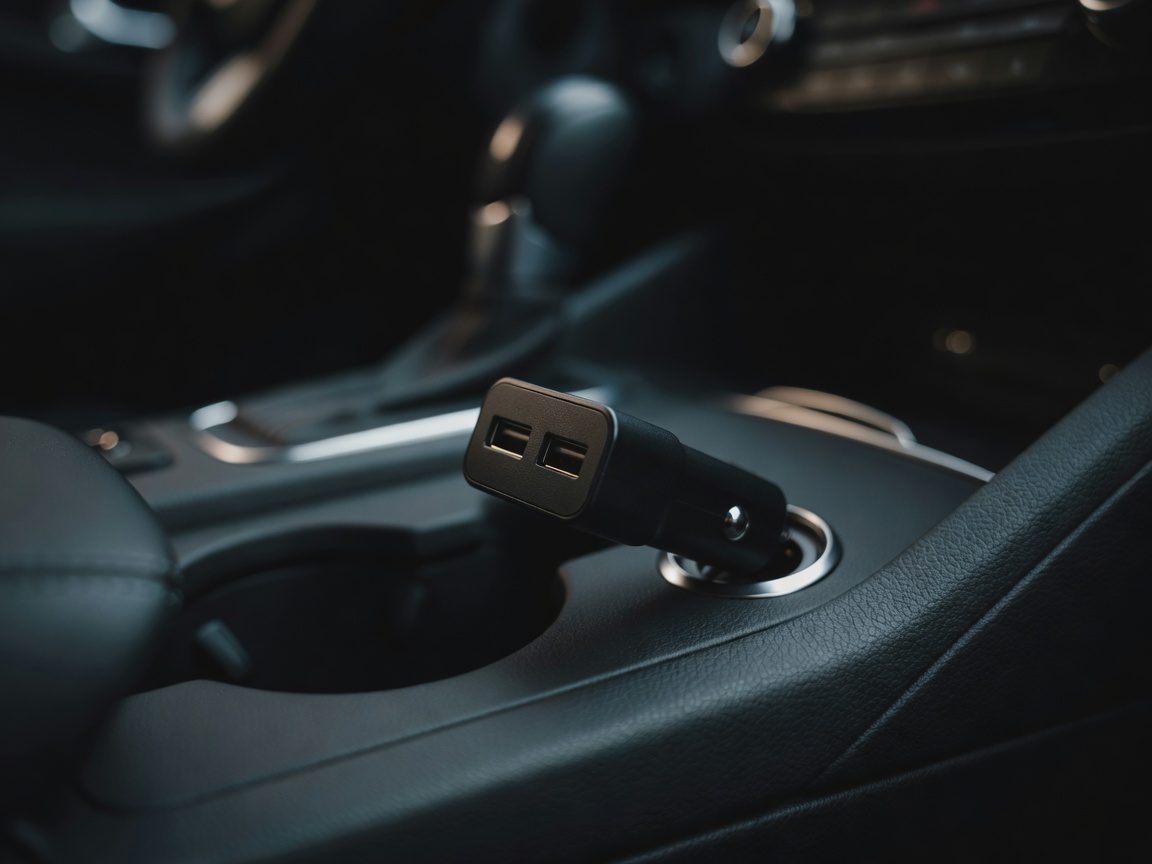
The Problem with Built-In Car Ports
Modern vehicles often come equipped with an array of USB ports integrated directly into the dashboard or center console. While convenient for establishing Apple CarPlay or Android Auto data connections, these built-in ports are historically underpowered for charging. Most output a meager 1A (5W) to 2.1A (10W). If you are running GPS navigation, streaming music, and have the screen brightness turned up, a 5W port will likely barely maintain the battery percentage, let alone charge it.
To achieve meaningful charging during short 20-minute commutes, you need to bypass the data ports and tap into the 12V auxiliary power outlet (traditionally known as the cigarette lighter socket).
Understanding the 12V Socket Limits
A standard car 12V socket is typically fused at 10 to 15 amps, meaning it can safely deliver between 120W and 180W of total power. This gives aftermarket car charger manufacturers massive headroom to create powerful devices. High-end car chargers can now comfortably output 65W or more via USB-C Power Delivery, easily enough to rapid-charge a modern smartphone or even top up a work laptop while on the road.
Flush Fit vs. Protruding Designs
When selecting a car charger, physical form factor is almost as important as wattage. The location of your 12V socket heavily dictates which style is appropriate.
- Flush Fit: These ultra-compact chargers sit perfectly level with the rim of the socket. They feature pull-tabs to remove them. These are ideal if your 12V socket is located behind a sliding console door or flap that you wish to close when cables aren't in use.
- Protruding: These sit an inch or more out from the socket. While less aesthetically sleek, the extra physical volume allows for better heat dissipation and room for complex internal circuitry, making them necessary if you want very high wattage (e.g., dual 30W ports).
Thermal Management in Extreme Environments
Car chargers face environmental extremes that wall chargers do not. A car parked in the summer sun can reach interior temperatures exceeding 140°F (60°C). Electronic components degrade rapidly under intense heat. High-quality car chargers utilize full aluminum alloy bodies rather than cheap plastic. The metal acts as a heat sink, drawing heat away from the internal transformer coils and shedding it into the cabin air, preventing thermal throttling during charging.
Dual Port Considerations
For road trips or rideshare drivers, dual or triple port chargers are essential. Pay close attention to how the power is split. A "40W Dual Charger" might split its power as 20W + 20W, which is excellent for fast-charging two phones simultaneously. However, a "45W Dual Charger" might split as 30W + 15W. Ensure the power distribution curve matches the devices you and your passengers bring into the cabin.