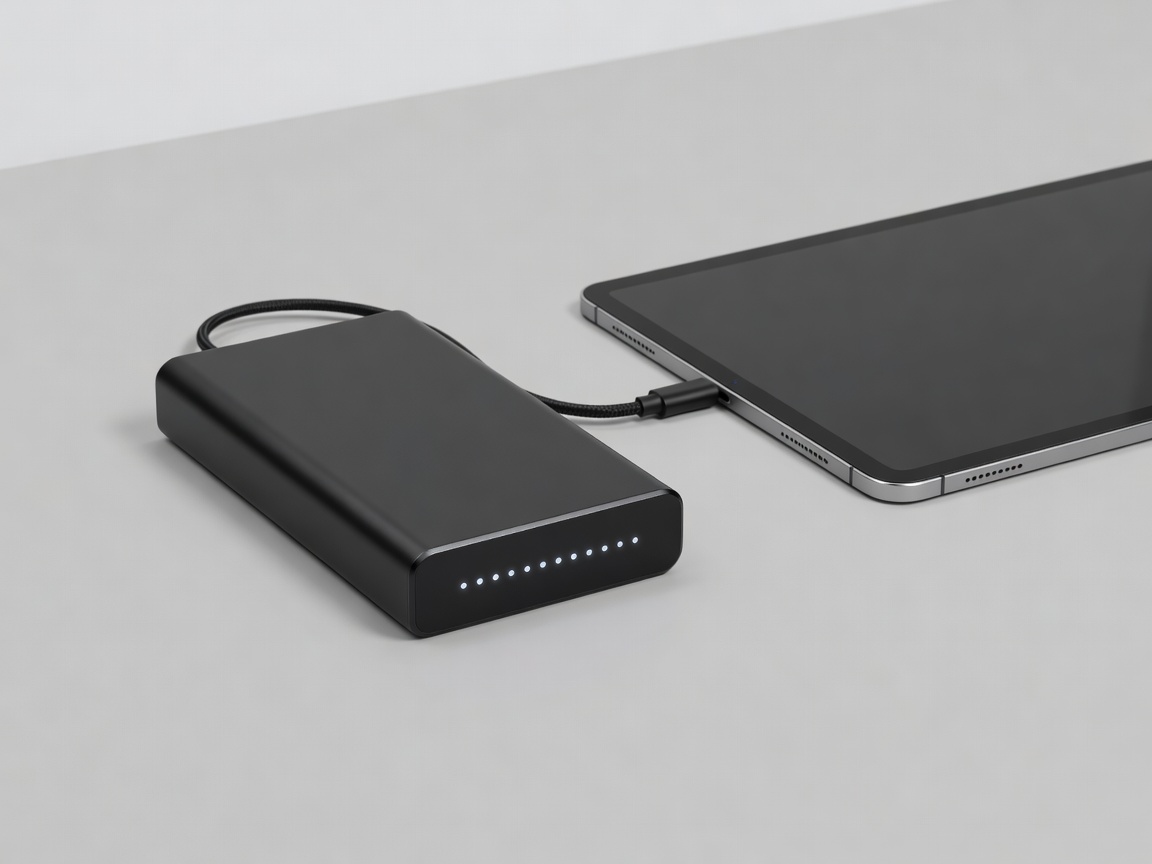
Translating Capacity (mAh)
The primary metric used to market power banks is milliampere-hours (mAh). Common sizes range from 5,000 mAh to robust 26,800 mAh bricks. However, consumer math regarding these numbers is often slightly off. If you have a phone with a 5,000 mAh battery, a 10,000 mAh power bank will not charge it exactly two times.
This discrepancy is due to voltage conversion and energy loss. Internal power bank cells typically operate at 3.7 volts, while USB output is stepped up to 5 volts (or higher for fast charging). This conversion, along with heat loss through the cable and device, means real-world efficiency is usually between 70% and 80%. A 10,000 mAh pack will reliably deliver about 7,500 mAh of usable charge to your devices.
Airline Regulations and Watt-Hours
Airlines tightly regulate lithium-ion batteries due to fire risks in unpressurized cargo holds. Power banks must be carried in cabin baggage; they are strictly prohibited in checked luggage. The universal cap set by the FAA and international bodies is 100 Watt-hours (Wh) without needing airline approval.
To convert mAh to Wh, use the formula: (mAh * Volts) / 1000 = Wh. Given the standard 3.7V internal cell voltage, a 26,800 mAh power bank equals roughly 99.1 Wh, making it the absolute largest capacity you can legally take on a flight without asking the airline for special permission. When buying a large power bank for travel, ensure the Wh rating is explicitly printed on the chassis, as security agents will look for this.
Output Wattage: Not Just For Phones
A high-capacity power bank is useless if it delivers power at a trickle. Just like wall adapters, portable chargers adhere to output limits. A standard 10,000 mAh pack might only output 15W. While fine for a smartphone over a few hours, it won't be enough to charge a modern laptop, which might actually drain faster than the power bank can supply energy.
Premium power banks now feature USB-C Power Delivery outputs of 45W, 65W, or even 100W+. These are essential if you plan to extend the battery life of a MacBook, Dell XPS, or Steam Deck while off the grid. Conversely, check that the power bank accepts high-wattage inputs for recharging itself; a 26,800 mAh block that only accepts 10W input will take over 12 hours to refill.
Pass-Through Charging
Pass-through charging is a highly sought-after feature for frequent travelers. It allows you to plug the power bank into the wall, and plug your phone into the power bank. The power intelligently routes to charge the phone first, and uses any surplus to refill the power bank's internal cells.
This means you only need a single wall charger and one outlet in a hotel room to wake up with both a fully charged phone and a fully charged backup battery. Be aware that constant pass-through charging can generate excess heat and degrade the power bank's cells over time, so it should be used out of convenience rather than as a permanent daily setup.
Form Factor and Cell Types
Lithium-ion (cylindrical 18650 cells) power banks are thicker and heavier but often cheaper. Lithium-polymer (Li-Po) packs use flat pouch cells, allowing for incredibly slim, credit-card sized form factors that slip easily into a jacket pocket. Consider your typical usage: a slim 5,000 mAh Li-Po bank is perfect for an evening out, while a chunky, ruggedized 20,000 mAh Li-Ion bank is better suited for a weekend camping trip.